City news · Gdańsk
Gdańsk: Naftoport, a key gateway for Poland’s oil supplies
Naftoport marks 35 years as an independent company. The terminal connects seaborne oil arrivals with Polish and German refineries. New infrastructure is intended to strengthen capacity and the operational reserve.
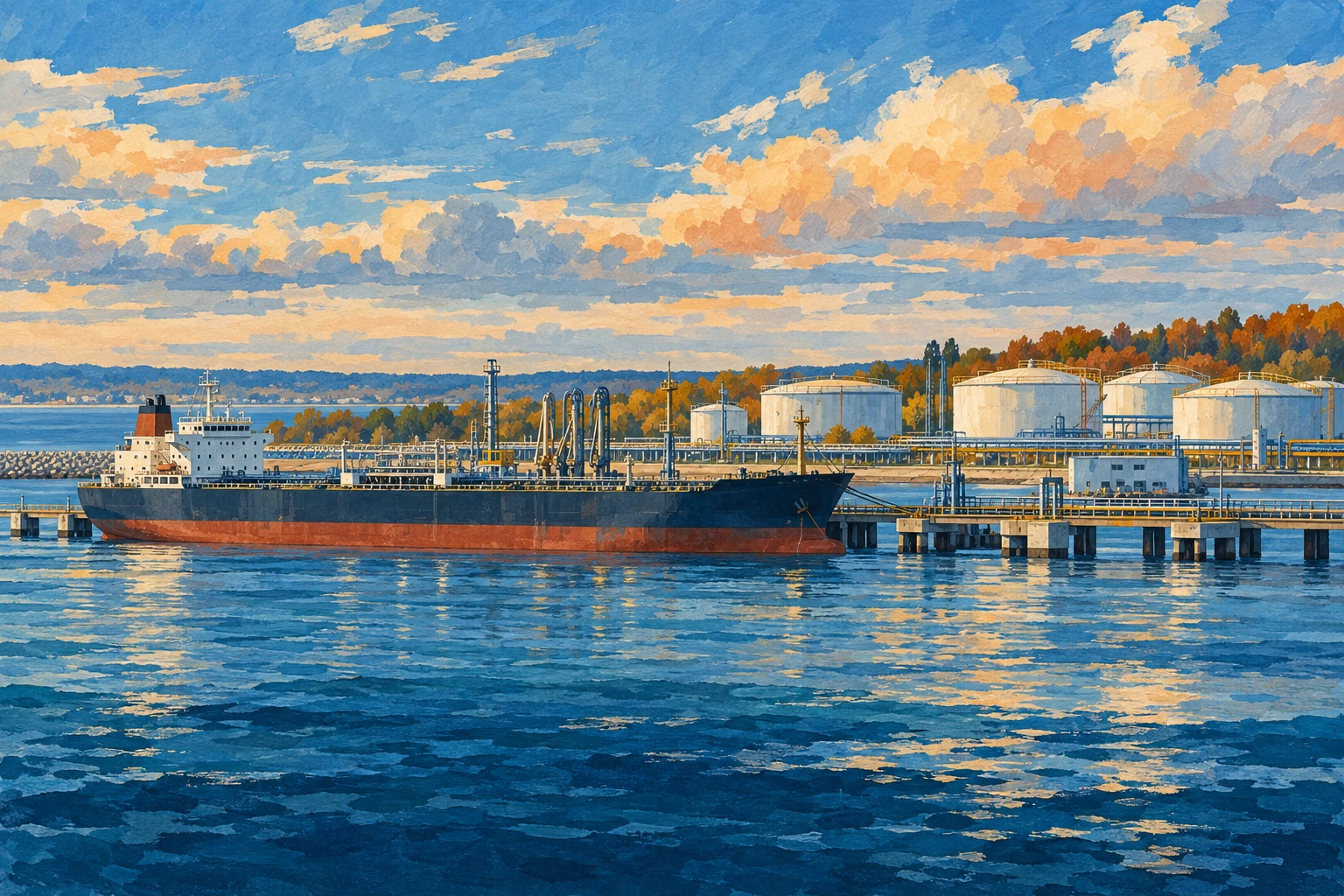
Original AI-generated illustration: an interpretation of Baltic oil logistics. It does not reproduce Naftoport’s actual layout.
In Gdańsk, an industrial anniversary tells part of the story of Poland’s energy development. In 2026, Naftoport marks 35 years of operating as an independent company, a status acquired in 1991. The terminal now belongs to the PERN group, which operates oil transport and storage infrastructure, among other facilities.
From the sea to refineries
The terminal’s role extends beyond its quays. Cargo arrives by ship, and the infrastructure connects to PERN’s pipelines and facilities. This network enables oil to reach Polish refineries and two German refineries.
The city of Gdańsk emphasises that changing supply origins and moving away from Russian oil have increased the importance of this maritime gateway. Diversifying arrivals therefore depends on a chain connecting the port to users of crude oil.
Activity on a large scale
For 2025, the published figures report 38.65 million tonnes of oil and petroleum products handled. Crude oil accounts for 37.4 million tonnes, a record for that category according to the operator. These volumes describe the previous year and should not be presented as a result already achieved for 2026.
A sixth handling berth under construction
Naftoport is developing a sixth handling berth with the Port of Gdańsk. It is intended to accommodate large VLCC tankers. PERN describes additional capacity of around nine million tonnes a year, alongside a larger operational reserve.
The practical goal is to provide more flexibility in arranging arrivals and maintaining continuity of operations. For understanding Gdańsk’s place in Poland’s economy, the project shows how the port, pipelines and refineries form a single logistics system.