Visiting Poland · Practical guide
First trip to Poland: practical tips for a smooth journey
Which documents should you bring? How should you pay? What should you check before boarding a tram? Practical pointers for French travellers, from planning to their first hours in Poland.

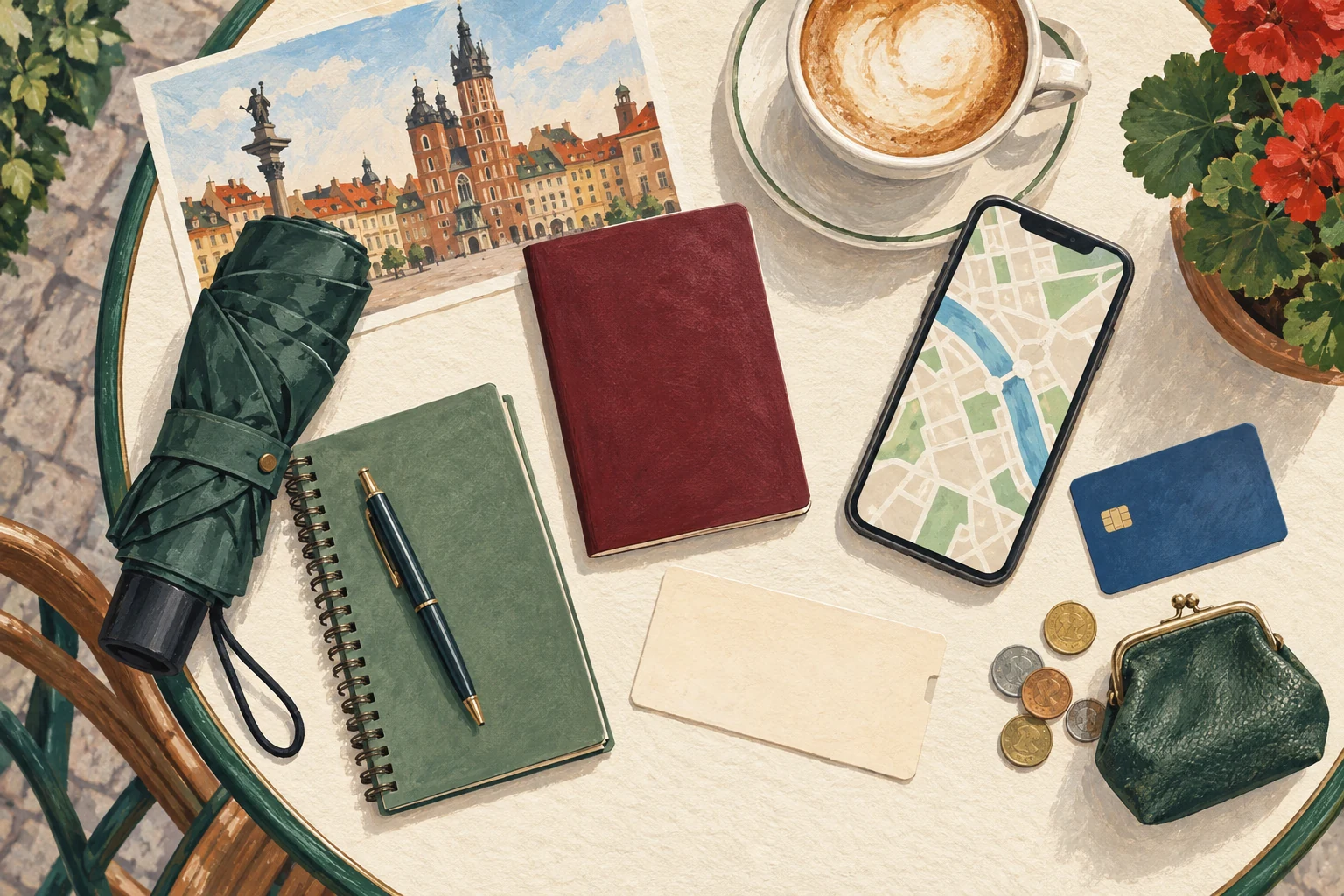
Original AI-generated illustration. An artistic composition inspired by several Polish cities, not a depiction of one location.
A café terrace in Kraków, a walk through Warsaw, a train towards the Baltic coast… A first trip to Poland often starts with a wish to explore, followed by a few practical questions. These pointers will help you prepare for your arrival and enjoy the journey.
Before you leave: check your documents
French citizens can enter Poland with a valid national identity card or passport. If your identity card shows an expired date but benefits from a French validity extension, France Diplomatie recommends using a valid passport to avoid difficulties.
Source: France Diplomatie — entry and stay.
Save your accommodation address, booking confirmation and insurance contact details somewhere you can access offline.
Money: get familiar with złotys
Poland’s currency is the złoty, abbreviated PLN. Displayed prices are therefore not amounts in euros.
Before leaving, check your card’s foreign-currency payment fees, withdrawal fees and limits. At an ATM or payment terminal, read the amount, currency and any charges before confirming.
Having a small amount of cash can be useful, without carrying your entire holiday budget.
Source: Polish National Tourist Office.
At the airport: plan your first journey
Your first decision will often be how to reach the city centre or your accommodation. Before flying, check the transport section of your arrival airport’s official website.
Compare the whole journey: fare, connections, walking with luggage and arrival time. The cheapest ticket may not be the most comfortable option after a late flight.
Save your accommodation’s exact address and any entry code. A screenshot is useful when your battery or connection lets you down.
Trains, trams and buses: take a minute to check
Before buying a ticket, check four things: the network, the route covered, the validity period and the activation or validation procedure.
Do not automatically apply habits learned in another city. Read the local network’s instructions, particularly before your first journey.
For train travel, double-check the departure station, time and, where shown on the ticket, carriage and seat number.
Phone: check your plan before travelling
Poland is covered by the EU’s “roam like at home” system. Fair-use limits and specific conditions may still apply, particularly to mobile data. Check your European data allowance with your provider.
Source: European Commission — roaming.
Download an offline map and keep your bookings on your phone. A small power bank can save you from having to choose between checking directions and showing a ticket.
A few words to get started
You do not need to master Polish to prepare a few simple exchanges. The pronunciation column below is designed for French speakers, as this guide is intended for travellers from France.
| Meaning | Polish | Pronunciation for French speakers |
|---|---|---|
| Hello | Dzień dobry | Djègne DOB-ri |
| Thank you | Dziękuję | Djièn-KOU-yè |
| Please | Proszę | PRO-chè |
| Do you speak English? To a man | Czy mówi Pan po angielsku? | Tchi MOU-vi pane po ang-GUIÈL-skou ? |
| Do you speak English? To a woman | Czy mówi Pani po angielsku? | Tchi MOU-vi PA-ni po ang-GUIÈL-skou ? |
| The bill, please | Poproszę rachunek | Po-PRO-chè ra-KHOU-nèk |
Capital letters mark the stressed syllable. Read “ch” as in French “chat”; “kh” is a slightly rasping breath. This transcription is approximate: some Polish sounds have no exact French equivalent.
If you have a food allergy, prepare a precise written explanation to show staff and confirm that they have understood it.
If something goes wrong: keep contacts handy
112 connects you to emergency services free of charge within the European Union. It is for situations requiring an urgent response.
Source: European Commission — emergency number 112.
Before leaving, also save your insurer’s assistance number, your bank’s card-blocking number and French consular contact details. You will save time if a problem occurs.
Before closing your suitcase
Getting off to a good start does not require planning everything. A few preparations leave more time for meeting people, walking and discovering new places.