History and heritage · Malbork
Malbork: the brick fortress telling eight centuries of history
On the Nogat River, Malbork looks like a setting from a medieval tale. Behind its red walls lies a real history: the Teutonic Knights, Poland’s kings and heritage rebuilt after the war. Discover the keys to understanding it.
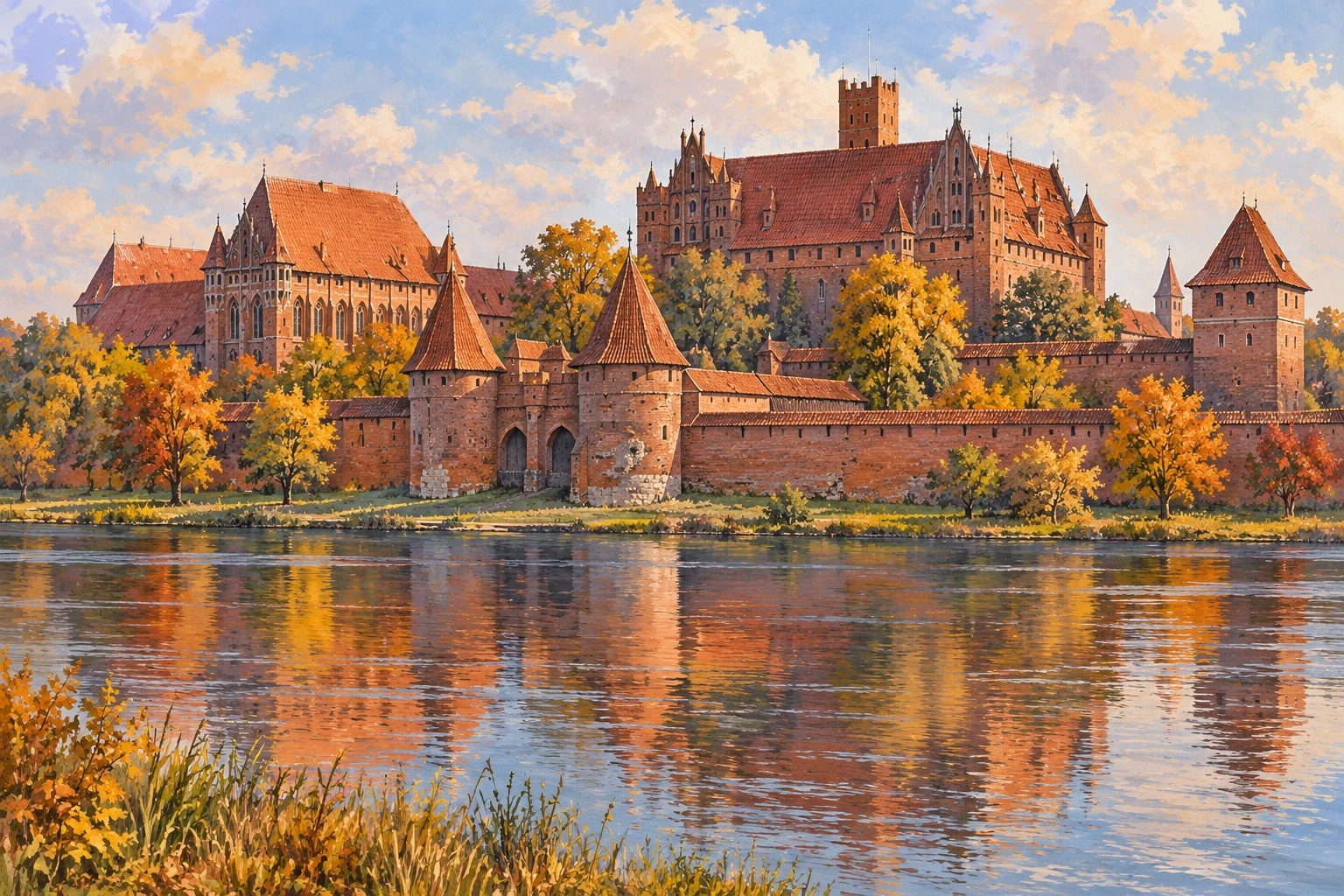
Original AI-generated illustration: a painted view inspired by Malbork Castle and the Nogat River. Architectural details are interpreted; this is not a photograph.
A silhouette to discover before entering
Some landmarks are best understood from a distance. In Malbork, take time to view the complex from the banks of the Nogat: roofs overlap, walls stretch out and brick gives the landscape its distinctive colour. Even before entering, you sense that this is more than a residence.
That first impression is an excellent starting point. Do not immediately try to photograph everything. Observe the different building masses, then imagine movement between living quarters, centres of power and defences. Your walk becomes preparation for the visit.
1309: Malbork becomes a centre of power
The fortress has medieval origins. A turning point came on 14 September 1309, when Grand Master Siegfried von Feuchtwangen moved his seat to Malbork. The castle became the centre of the Teutonic Order’s power in Prussia.
The Teutonic Knights belonged to a religious and military order. The site therefore combined several functions: a community’s residence, the organisation of power and defence. Keep these three dimensions together when reading the architecture, rather than seeing only a backdrop for battles.
Following this move, the complex grew and changed. Visiting Malbork means entering a system organised around a powerful institution, whose relations with neighbours, including the Kingdom of Poland, involved rivalry and conflict.
Three parts to understand the fortress
Malbork comprises the High Castle, Middle Castle and a vast outer precinct, often called the Lower Castle. This arrangement distinguishes conventual spaces, ceremonial areas and buildings serving everyday needs.
The Grand Masters’ Palace and Great Refectory belong to the Middle Castle. The outer precinct housed facilities supporting the complex, including stores and workshops. Behind the monumental facades, people had to be fed, accommodated, administered and supplied.
Look for these changes of scale during your visit. A courtyard, gateway or room looks different when you ask what it was used for. This thread helps you find your way without reducing the monument to a sequence of rooms.
1457: a new life under Poland’s kings
In June 1457, during the Thirteen Years’ War, Malbork came under Polish control. The museum explains that its administration was entrusted to representatives of royal authority. The former Teutonic capital changed function.
Spaces were repurposed: the High Castle was used for storage, while the Middle Castle accommodated soldiers and officials. The monument did not freeze in time when its former occupants left; it continued to live through new uses.
This period explains why it would be misleading to describe Malbork only as a Teutonic castle. Its history also belongs to the Polish monarchy. Changes in the site reveal political shifts as clearly as dates in a textbook.
From Prussia to restoration: a changing monument
In 1772 the castle passed under Prussian administration. It then underwent alterations and deterioration before becoming a major subject of study and restoration in the nineteenth and twentieth centuries.
This chapter matters: the medieval appearance we discover today also reflects conservation choices. Restoring a monument means understanding old traces, but also deciding how to present them and which parts to rebuild.
Malbork is not a time capsule sealed since the Middle Ages. Each period left its mark. That is precisely what makes a visit interesting beyond the beauty of its walls.
1945, then 1997: rebuilding and passing on heritage
The castle was severely damaged in 1945. Reconstruction resumed after the war, and the Castle Museum was established in 1961. Conservation became central to the site’s history.
In 1997 Malbork entered UNESCO’s World Heritage List. This recognition highlights its importance as an example of a medieval brick castle and the value of its architectural and heritage history.
Today’s visit combines surviving fabric, restoration and reconstruction. The museum’s explanations help you understand these layers. Pay as much attention to how the site was saved as to the power it once symbolised.
The Great Refectory: looking at the vaults
The Great Refectory deserves a pause. The museum describes it as the castle’s largest room, with a remarkable palm vault. It reveals the collective and ceremonial dimension of life within the complex.
Stop, observe how the ribs spread, then look at the light crossing the room. Attention to detail gives a visit greater depth than simply moving from one space to the next.
The accompanying illustration is an artistic interpretation. It invites you to discover the atmosphere of a Gothic interior; it does not replace the museum’s photographs or precise documentation of the decoration.
Planning your visit without rushing
To discover the history and interiors, look at the museum’s Trasa Historyczna, the historical route. A French audioguide is among the advertised options. Check the ticket’s coverage: a walk through the grounds does not necessarily include the same spaces.
We suggest setting aside a substantial part of the day for Malbork, with a break and a walk around the castle. In autumn bring comfortable shoes and a warm layer: the visit combines indoor spaces and outdoor passages.
Hours are seasonal. Check the official page and ticket system for your chosen date, especially the last departure and available rooms. If travelling by train, check your journey to Malbork and the return before buying museum tickets.